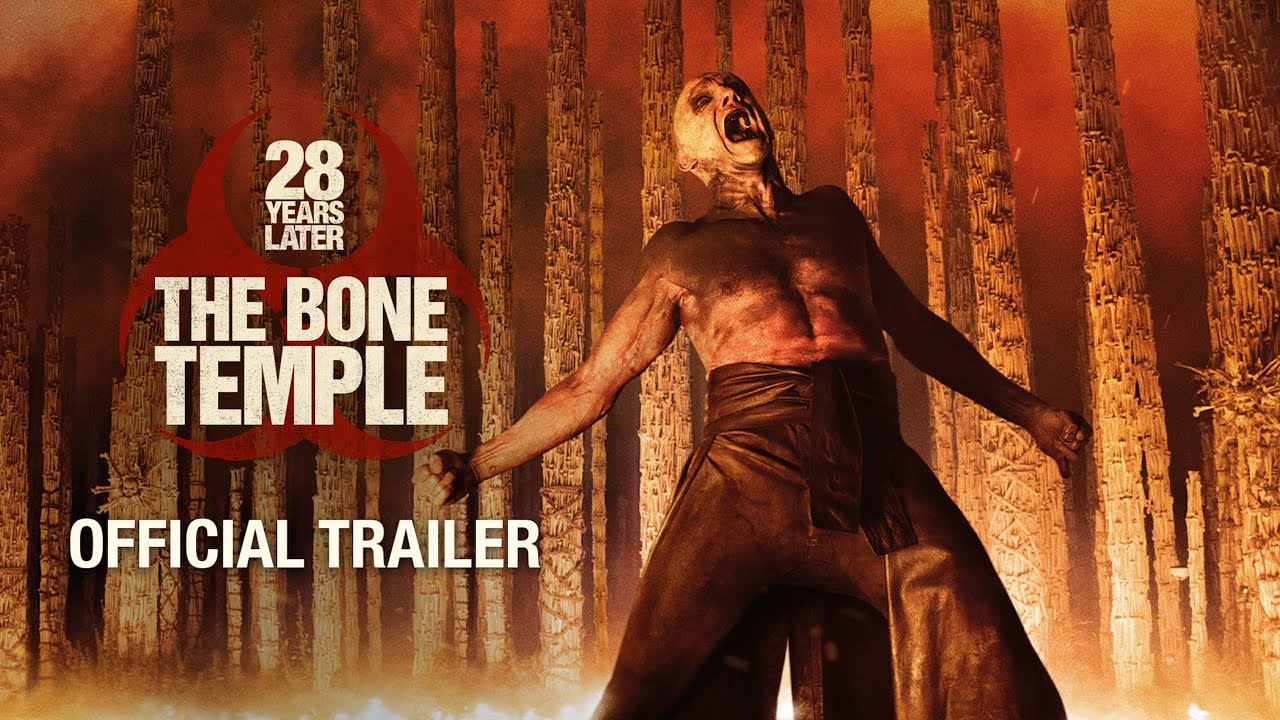
Watch 28 Years Later: The Bone Temple (2026) full
28 Years Later: The Bone Temple, directed by Nia DaCosta, written by Alex Garland. Screening at AMC Theatres, Kendall Square Cinema, and other New England movie houses.
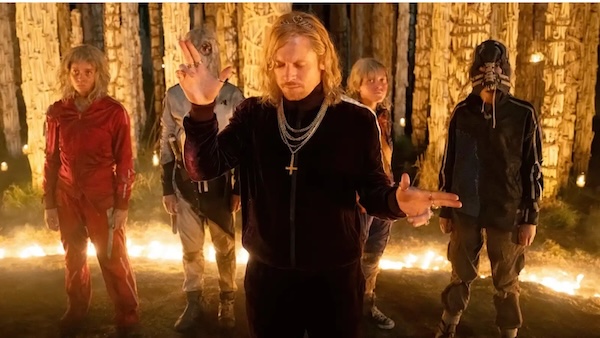
Jack O’Connell as Sir Lord Jimmy Crystal in a scene from 28 Years Later: The Bone Temple. Photo: Sony Pictures.
I don’t usually like to tell people how to prepare to see movies, but in the case of 28 Years Later: The Bone Temple, I’d recommend watching (or rewatching) 28 Years Later before you see the newest installment in this prestigious franchise. Written by Alex Garland, directed by Danny Boyle, and photographed by Anthony Dod Mantle (the creative team behind the original 28 Days Later (2002)), 28 Years Later begins with an auspicious prologue that introduces one of The Bone Temple‘s major characters. Jimmy is a towheaded boy with many blond siblings. Jimmy presumably escapes. At the end of that film, we meet Jimmy, 28 years after he has fled his home, in the guise of Sir Lord Jimmy Crystal (Jack O’Connell), wearing his father’s gold crucifix upside down, surrounded by wiry young mercenaries in velveteen track suits with mad martial arts skills. It’s a very unexpected and weird ending, a cliffhanger that posits a micro-mythology born in a world where people struggle day and night for survival.
In both 28 Days Later and 28 Weeks Later (2007), we learn that people have retreated to rural areas, holing up in deserted country manors and farm estates, living in well-built timber houses and barns that, nevertheless, are not always hefty enough to keep out the ravenous infected. In George Romero’s final film, Survival of the Dead (2009), the living also relocate to the literal ends of the earth, but even though they have escaped the zombie hordes, survivors end up battling each other. Postapocalyptic narratives tend to be most interesting when they focus on the kinds of destructive behaviors that led to the calamitous event, including the perennial human tendency to create cults of personality.
As The Bone Temple begins, Jimmy and his weird accumulation of young blond-wigged henchlings (all named Jimmy) have kidnapped 12-year-old Spike (Alfie Williams, a fine young actor), a character who, at the end of 28 Years Later, left his protected island community in order to explore the dangerous mainland after the death of his mother. . The hermetic doctor now has an erstwhile companion: a muscular “alpha” (the name given to those infected in the first wave in 2002) whom Kelson has named Samson (Chi Lewis-Parry in a powerful, nearly wordless performance). Apparently, Samson visits the bone temple often; in response, Kelson has made a gun that fires morphine darts that render him calm and harmless. Kelson’s lonely existence is soothed by his interactions with this giant, naked man, who is covered in scars and is capable of tearing human beings in half with his bare hands.
The mysterious persona of Kelson is further illuminated by glimpsed relics of his past: photos of him with his wife, and ’80s vinyl records he plays on a generator-powered turntable. But these are among the many unexplained plot points in the film that audiences are expected to take on faith.
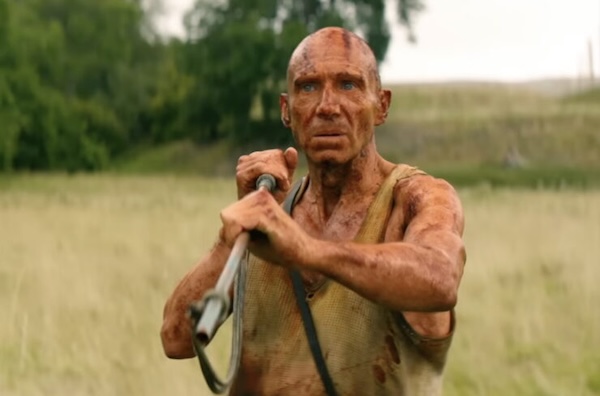
Ralph Fiennes in a scene from 28 Years Later: The Bone Temple. Photo: Sony
Speaking of faith, Bone Temple’s dramatic centerpiece is a ritualized cat-and-mouse spectacle that exposes Jimmy Crystal’s bizarre obsession with being the son of Satan. Fiennes is brilliant in the scene, which is often quite clever and funny, propelled by a myriad of cultural homages. To say more would veer into spoiler territory, but it’s an entertaining sequence that, thankfully, comes after a horrific scene of violence (the film contains many). Is the violence and gore somewhat overdone — to the point of being gratuitous? To me, it is: sometimes, quality means more than quantity. As well, the prevalence of frenzied close-up shots and loud jump scares feels repetitive and pointless.
Garland penned the screenplay, but this iteration featured a new director, Nia DaCosta (Candyman, Hedda), and a new cinematographer, Sean Bobbitt (Hedda, 12 Years a Slave). 28 Years Later also had a complete artistic team shift, which included a different director, writers, and cinematographer. This creative move seemed to make more sense, given that a decade had passed and the film, though panned by many fans and some critics, was a well-realized sequel.
Still, fans of this ongoing horror narrative will find much to appreciate here. The performances are great across the board, including O’Connell, who makes Jimmy a terrifyingly malignant yet charismatic force.